Welcome To ScivoraHub Educational Platform

What Is Deep Learning AI? How It Works, Applications & Future (2026 Guide)
Learn what Deep Learning AI is, how it works, its real-world applications, benefits, challenges, and future in this beginner-friendly 2026 guide.
AIARTIFICIAL INTELLIGENCE
ScivoraHub Editorial Team
7/12/20266 min read
What Is Deep Learning AI? How It Works, Applications & Future (2026 Guide)
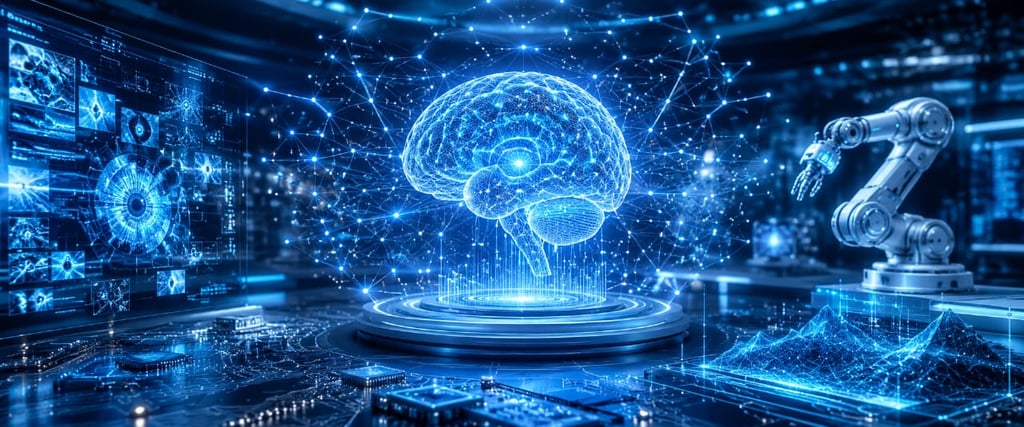
Deep Learning AI is one of the most advanced branches of artificial intelligence, enabling machines to learn from massive amounts of data and perform tasks that once required human intelligence. From recognizing faces and understanding speech to powering self-driving cars and medical diagnosis, deep learning is transforming industries worldwide.
In this comprehensive guide, you'll learn what Deep Learning AI is, how it works, how it differs from machine learning, its real-world applications, key benefits, challenges, and what the future holds for this revolutionary technology. Whether you're a student, developer, or simply curious about AI, this guide will help you understand deep learning in a simple and practical way
What Is Deep Learning AI?
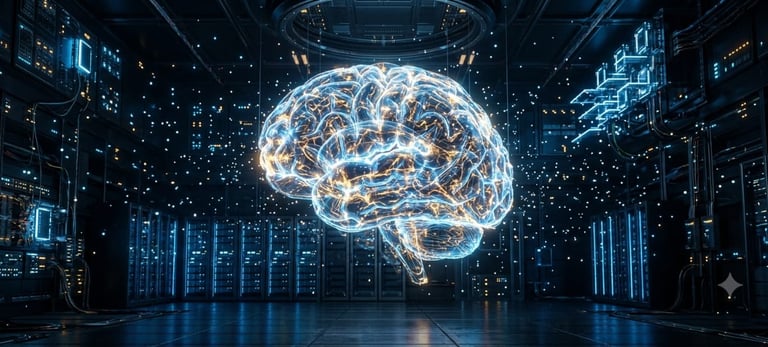
Deep Learning AI is a specialized branch of Artificial Intelligence (AI) and Machine Learning (ML) that enables computers to learn from massive amounts of data without being explicitly programmed for every task. It uses artificial neural networks, inspired by the structure of the human brain, to recognize patterns, analyze information, and make intelligent decisions.
Unlike traditional computer programs that follow fixed rules, deep learning models improve their performance by learning from experience. The more high-quality data they process, the more accurate and efficient they become. This ability has made deep learning one of the most powerful technologies driving today's AI revolution.
Deep learning is already part of everyday life. It powers facial recognition on smartphones, voice assistants, language translation, recommendation systems on streaming platforms, medical image analysis, autonomous vehicles, fraud detection, and many other intelligent applications.
Why Is It Called "Deep" Learning?
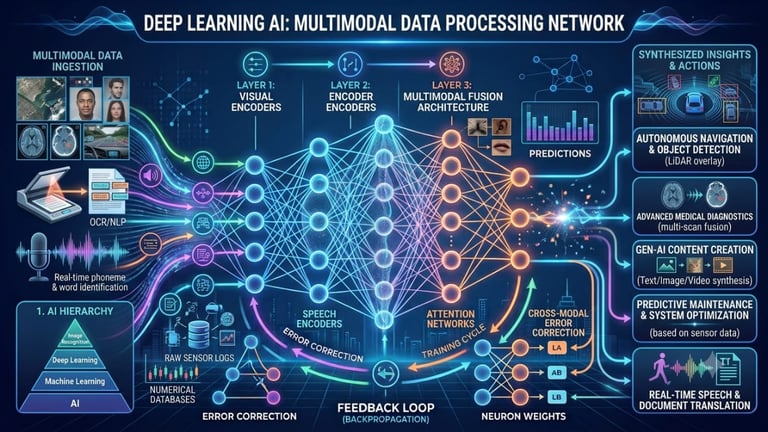
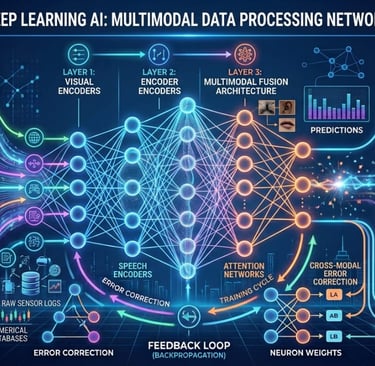
The word "deep" refers to the multiple hidden layers inside an artificial neural network. These layers process information step by step, allowing the AI model to understand increasingly complex patterns. Each layer extracts more detailed features from the input data, enabling highly accurate predictions and decisions.
For example, when identifying a cat in an image, the first layer may detect simple edges, the next layer identifies shapes, another recognizes facial features, and the final layer determines that the object is a cat
How Does Deep Learning Work?
Deep learning works by processing information through multiple layers of artificial neurons. Each layer analyzes the input data, identifies patterns, and passes the refined information to the next layer. This layered approach allows AI systems to solve complex problems with remarkable accuracy.
The process begins when the model receives input data such as images, text, audio, or numerical information. The first layer extracts basic features, while deeper hidden layers identify increasingly complex relationships. Finally, the output layer produces a prediction, classification, or decision based on everything the model has learned.
Unlike traditional software, deep learning models improve through training. During training, they analyze thousands or even millions of examples, compare predictions with correct answers, calculate errors, and adjust their internal parameters. Over time, this continuous learning process makes the model more accurate and reliable.
Key Components of Deep Learning
Deep learning systems typically include the following components:
Input Layer – Receives raw data such as images, text, or speech.
Hidden Layers – Process and transform information through multiple stages.
Neurons – Small computing units that detect patterns and relationships.
Weights and Biases – Parameters that the model adjusts during training.
Output Layer – Produces the final prediction or result.
Deep Learning vs Machine Learning
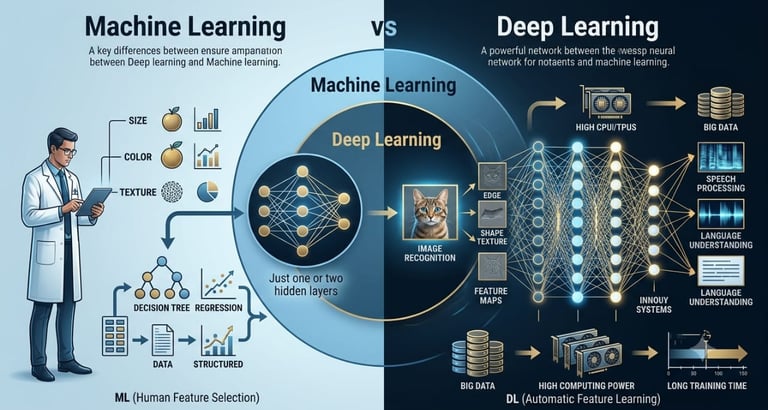
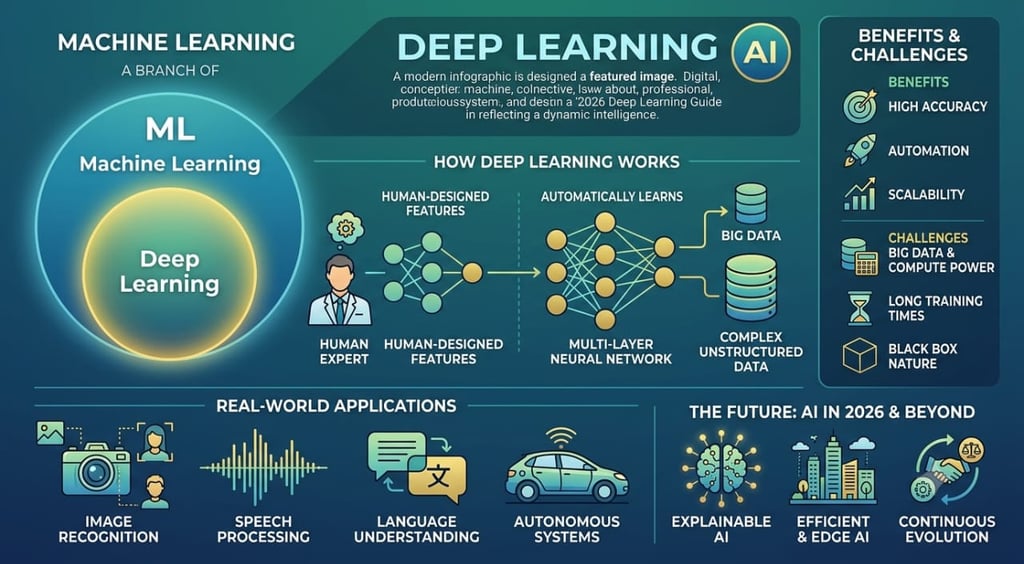
Although Deep Learning is a subset of Machine Learning, the two technologies are not the same. Machine Learning often relies on structured data and may require humans to manually select important features before training a model. Deep Learning, on the other hand, uses multi-layer neural networks that automatically learn features from large datasets.
Machine Learning is generally suitable for smaller datasets and simpler prediction tasks, while Deep Learning excels at solving complex problems such as image recognition, speech processing, natural language understanding, and autonomous driving. However, Deep Learning typically requires more computing power, larger datasets, and longer training.
Key Differences
Feature Machine Learning Deep Learning
Data Requirement Small to Medium Large
Feature Engineering Manual Automatic
Training Time Faster Slower
Accuracy Good Very High
Best For Structured Data Images, Speech,Text
Introduction
Deep Learning AI is no longer limited to research laboratories. Today, it powers many technologies that people use every day. From healthcare and finance to transportation and education, deep learning is helping organizations solve complex problems, automate tasks, and improve decision-making with remarkable accuracy. Deep Learning is also transforming AI in Education by enabling personalized learning, intelligent tutoring systems, and automated assessment.
🟢 Healthcare
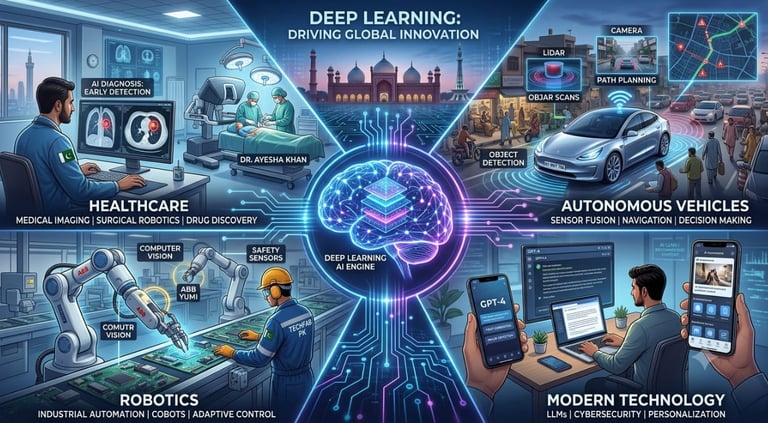
Deep learning helps doctors analyze X-rays, MRI scans, and CT images more accurately. AI models can detect diseases at an early stage, support medical diagnosis, and assist healthcare professionals in providing faster treatment. It is also used in drug discovery and personalized medicine.
🟢 Self-Driving Vehicles
Autonomous vehicles rely on deep learning to recognize roads, pedestrians, traffic signs, and nearby vehicles. By processing real-time camera and sensor data, these AI systems can make driving decisions safely and efficiently.
🟢 Natural Language Processing (NLP)
Deep learning enables AI assistants and language models to understand and generate human language. Applications include chatbots, language translation, speech recognition, text summarization, and intelligent virtual assistants.
🟢 Computer Vision
Computer vision uses deep learning to identify faces, objects, handwritten text, and scenes in images and videos. This technology is widely used in security systems, manufacturing, retail, and smartphone facial recognition.
🟢 Education
In education, deep learning powers adaptive learning platforms, AI tutors, automated grading, and personalized study recommendations. It helps students learn at their own pace while supporting teachers with intelligent educational tools.
Benefits of Deep Learning AI
Deep Learning AI has become one of the most powerful technologies because it can solve complex problems with remarkable speed and accuracy. As organizations generate more data, deep learning continues to improve automation, decision-making, and innovation across various industries.
🟢 Key Benefits
High Accuracy: Deep learning models can recognize patterns with exceptional precision, especially in image recognition, speech processing, and language understanding.
Automatic Feature Learning: Unlike traditional machine learning, deep learning automatically discovers important patterns from raw data, reducing manual effort.
Handles Massive Data: It performs exceptionally well with large datasets, making it ideal for modern AI applications.
Continuous Improvement: The more quality data a model receives, the better its predictions become over time.
Wide Industry Adoption: Deep learning is transforming healthcare, education, finance, cybersecurity, robotics, e-commerce, and autonomous vehicles.
Challenges of Deep Learning AI
Despite its impressive capabilities, Deep Learning AI also comes with several challenges that organizations must consider before implementation.
Common Challenges
Requires Large Amounts of Data
High Computing Power Requirements
Long Training Time
High Development Cost
Limited Explainability (Black Box Problem)
Privacy and Ethical Concerns
Although these challenges exist, ongoing research is making deep learning systems more efficient, transparent, and accessible.
Real World Applications of Deep Learning AI
The Future of Deep Learning AI
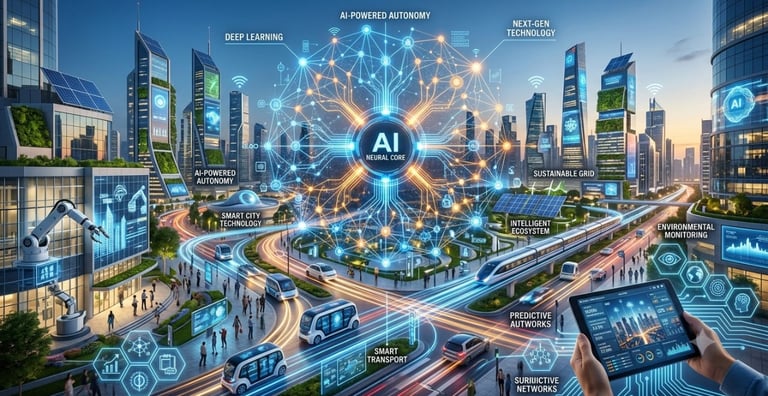
Deep Learning AI is expected to become even more powerful in the coming years. As computing hardware improves and larger datasets become available, AI models will become faster, more accurate, and more efficient. Future advancements are likely to transform industries such as healthcare, education, finance, manufacturing, and scientific research.
Emerging technologies like multimodal AI, autonomous robotics, AI-powered scientific discovery, and personalized digital assistants will rely heavily on deep learning. At the same time, researchers are working to make AI systems more transparent, energy-efficient, and trustworthy.
For students, professionals, and businesses, understanding deep learning today is an investment in the future, as it continues to shape the next generation of intelligent technologies
Conclusion
Deep Learning AI is one of the most significant breakthroughs in modern artificial intelligence. By using artificial neural networks to learn from vast amounts of data, it enables machines to recognize patterns, make accurate predictions, and solve complex problems across many industries. OpenAI (AI research)
From healthcare and education to self-driving vehicles and intelligent virtual assistants, deep learning is already changing the way we live and work. While challenges such as high computing costs and data requirements remain, continuous innovation is making this technology more accessible every year.
Whether you're a student, developer, researcher, or technology enthusiast, learning the fundamentals of Deep Learning AI will help you better understand the future of artificial intelligence and its growing impact on the world.
(FAQs)
Frequently Asked Questions
Empowering global education through Artificial Intelligence, innovation, and trusted educational insights
Disclamer | Privacy | Policy | Terms & Conditions | Articles | About us | Contact
© 2026 Scivora Hub. All Rights Reserved..
AI • Education • Innovation • Global LearningS