Welcome To ScivoraHub Educational Platform

Microsoft AI Explained: Complete Guide to Azure AI, Copilot & Microsoft's AI Ecosystem (2026)
Explore Microsoft's complete AI ecosystem in this 2026 guide. Learn about Microsoft Copilot, Azure AI, Azure OpenAI Service, AI Studio, enterprise AI tools, and how Microsoft AI powers modern businesses.
AI
ScivoraHub Editorial Team
7/25/20269 min read

Introduction
Artificial Intelligence has become one of the biggest drivers of digital transformation, helping businesses improve productivity, automate workflows, and make faster data-driven decisions. Among the world's leading technology companies, Microsoft has established itself as a major force in enterprise AI by integrating artificial intelligence across its cloud platform, productivity software, developer tools, and business solutions.
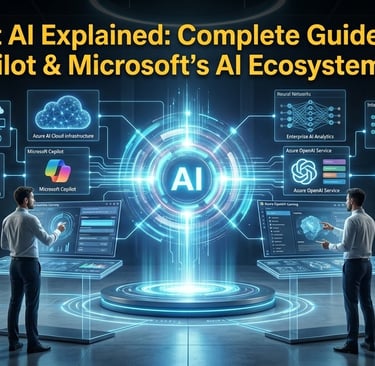
Rather than offering a single AI product, Microsoft has created a complete AI ecosystem that connects Azure AI, Microsoft Copilot, Azure OpenAI Service, AI Studio, and intelligent cloud services into one unified platform. This ecosystem allows developers, businesses, researchers, and organizations to build, customize, and deploy AI-powered applications securely and at scale.
One of Microsoft's greatest strengths is its focus on enterprise adoption. While many AI platforms primarily target consumers, Microsoft provides businesses with secure cloud infrastructure, advanced AI models, machine learning services, automation tools, and responsible AI frameworks that support real-world business operations. From document analysis and software development to customer support and business intelligence, Microsoft AI enables organizations to integrate intelligent automation into everyday workflows.
Microsoft has also invested heavily in strategic partnerships and AI research, making advanced language models and intelligent assistants accessible through enterprise-grade services. Products such as Microsoft Copilot have transformed the way professionals write documents, analyze data, generate code, manage meetings, and collaborate within Microsoft 365 applications.
Security and responsible AI development remain central to Microsoft's strategy. The company combines AI innovation with strong privacy controls, compliance standards, governance policies, and enterprise security features, giving organizations greater confidence when deploying AI solutions in sensitive industries.
Whether you're a student, developer, IT professional, business owner, or AI enthusiast, understanding Microsoft's AI ecosystem is becoming increasingly important. As artificial intelligence continues to reshape modern workplaces, Microsoft AI is expected to remain one of the most influential enterprise AI platforms in the years ahead.
In this comprehensive 2026 Guide, you'll explore Microsoft's complete AI ecosystem, learn how Azure AI, Microsoft Copilot, Azure OpenAI Service, and AI Studio work together, understand Microsoft's approach to responsible AI, and discover why Microsoft has become one of the global leaders in enterprise artificial intelligence.
Table of Contents
What Is Microsoft AI?
Understanding Microsoft's AI Ecosystem
Azure AI Explained
Microsoft Copilot Explained
Azure OpenAI Service
Microsoft AI Studio
Responsible AI at Microsoft
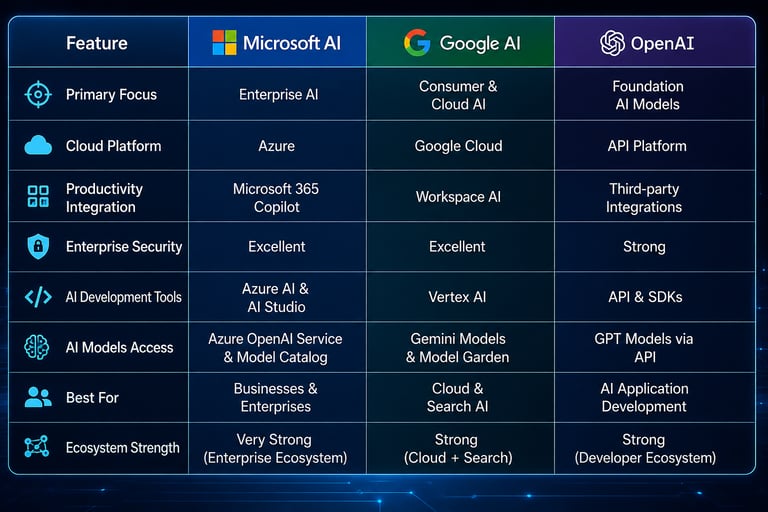
Microsoft AI vs Google AI vs OpenAI
Frequently Asked Questions
Conclusion
Key Takeaways
Microsoft AI is a complete ecosystem of AI services, developer tools, cloud infrastructure, and enterprise solutions.
Azure AI provides businesses with powerful AI models, machine learning services, and intelligent automation capabilities.
Microsoft Copilot enhances productivity by integrating AI into Microsoft 365, Windows, GitHub, and enterprise applications.
Azure OpenAI Service enables organizations to securely build AI-powered applications using advanced language models.
Microsoft AI emphasizes responsible AI, security, compliance, and enterprise-grade scalability.
Microsoft AI Explained: Complete Guide to Azure AI, Copilot & Microsoft's AI Ecosystem (2026)


What Is Microsoft AI?
Microsoft AI is a comprehensive ecosystem of artificial intelligence technologies, cloud services, developer platforms, and intelligent business solutions created to help individuals and organizations build, deploy, and manage AI-powered applications. Rather than focusing on a single AI product, Microsoft integrates artificial intelligence across its entire technology portfolio, making AI accessible through cloud computing, productivity software, enterprise applications, cybersecurity, and software development tools.
At the heart of Microsoft's AI strategy is Azure, its enterprise cloud platform that provides scalable infrastructure for machine learning, natural language processing, computer vision, speech recognition, and generative AI. Developers can use Azure AI services to build intelligent applications without creating AI models from scratch, while businesses can securely deploy AI solutions that meet enterprise security and compliance standards.
Microsoft has also expanded AI into everyday productivity through Microsoft Copilot, an intelligent assistant integrated into Microsoft 365, Windows, GitHub, and other Microsoft products. Copilot helps users generate content, summarize information, analyze data, write code, automate repetitive tasks, and improve workplace productivity using advanced AI models.
Another important part of Microsoft's ecosystem is Azure OpenAI Service, which gives organizations secure access to advanced language models within the Azure environment. This allows businesses to build customized AI applications while maintaining enterprise-level governance, privacy, and compliance.
Unlike many consumer-focused AI platforms, Microsoft AI is designed to support organizations of all sizes—from startups to global enterprises. By combining cloud computing, responsible AI principles, security, and intelligent automation, Microsoft has built one of the world's most comprehensive enterprise AI ecosystems.


Understanding Microsoft's AI Ecosystem
Microsoft's AI ecosystem is built around a connected network of cloud services, AI models, developer tools, and business applications that work together seamlessly. Instead of offering isolated AI products, Microsoft has created an integrated platform where different AI technologies share data, security, and computing resources.
The ecosystem begins with Azure Cloud, which provides the computing power required to train, deploy, and manage AI models. On top of this infrastructure, Azure AI delivers specialized services such as vision, speech, language, and machine learning capabilities. These services allow developers to add AI features to applications without building complex models from the ground up.
Microsoft Copilot brings AI directly into everyday productivity tools, while Azure OpenAI Service enables organizations to develop customized generative AI solutions. AI Studio provides a centralized environment for building, testing, and managing AI applications, making enterprise AI development faster and more efficient.
One of the biggest advantages of this ecosystem is its strong focus on enterprise security, compliance, and responsible AI. Every component is designed to work together, allowing businesses to scale AI projects confidently while protecting sensitive data and meeting regulatory requirements
Azure AI Explained
Azure AI is Microsoft's cloud-based artificial intelligence platform that enables developers and organizations to build, deploy, and manage AI-powered applications at enterprise scale. Instead of creating complex AI systems from scratch, Azure AI provides ready-to-use services, APIs, and machine learning tools that simplify AI development while maintaining high levels of security and performance.
The platform includes a wide range of capabilities, such as natural language processing, computer vision, speech recognition, document intelligence, machine translation, and custom machine learning models. These services allow businesses to integrate AI into websites, mobile apps, enterprise software, and customer support systems with minimal infrastructure management.
One of Azure AI's greatest advantages is its seamless integration with the Azure cloud ecosystem. Organizations can combine AI services with databases, analytics platforms, security solutions, and cloud computing resources to build intelligent applications that scale efficiently as business requirements grow.
Azure AI is widely used across industries such as healthcare, finance, manufacturing, retail, education, and government because it offers enterprise-grade security, global cloud infrastructure, compliance certifications, and flexible deployment options.


Microsoft Copilot Explained
Microsoft Copilot is an AI-powered assistant integrated across Microsoft's products and services to help users complete tasks faster and more efficiently. Rather than functioning as a standalone chatbot, Copilot works directly within familiar applications such as Microsoft Word, Excel, PowerPoint, Outlook, Teams, Windows, GitHub, and Dynamics 365.
Copilot understands natural language instructions and assists users with writing documents, summarizing lengthy reports, analyzing spreadsheets, generating presentations, composing emails, writing code, organizing meetings, and automating repetitive tasks. By combining advanced language models with Microsoft's productivity ecosystem, Copilot enhances both individual and team productivity.
A major strength of Microsoft Copilot is its ability to use organizational data securely while respecting enterprise permissions and compliance policies. This allows businesses to benefit from AI-powered assistance without compromising data security or regulatory requirements.
As Microsoft continues to expand Copilot across more products, it is becoming a central component of modern digital workplaces, enabling professionals to focus on strategic work while AI handles routine tasks.


Azure OpenAI Service
Azure OpenAI Service is Microsoft's enterprise platform that provides secure access to advanced AI models through the Azure cloud. It allows organizations to build AI-powered applications while maintaining enterprise-level security, privacy, governance, and compliance. Unlike public AI services, Azure OpenAI Service is designed specifically for businesses that need greater control over their AI infrastructure and data.
Developers can use Azure OpenAI Service to create intelligent chatbots, automate customer support, generate content, summarize documents, analyze business data, and build custom AI assistants. Because it operates within the Azure ecosystem, organizations can integrate AI directly with existing cloud services, databases, analytics platforms, and enterprise applications.
Another important advantage is scalability. Whether a company is developing a small internal AI assistant or deploying enterprise-wide AI solutions across thousands of users, Azure OpenAI Service provides the infrastructure required for reliable, high-performance AI workloads.


Microsoft AI Studio
Microsoft AI Studio is a development environment that helps teams design, test, customize, and manage AI applications from a single workspace. It simplifies the process of building AI solutions by providing tools for prompt engineering, model evaluation, workflow management, and application deployment.
Developers can experiment with different AI models, compare responses, optimize prompts, and integrate AI into enterprise applications without managing complex infrastructure. AI Studio also supports collaboration between developers, data scientists, and business teams, making enterprise AI projects more organized and efficient.
By bringing development, testing, and deployment into one platform, Microsoft AI Studio reduces complexity and accelerates the creation of production-ready AI applications.


Responsible AI at Microsoft
Microsoft places strong emphasis on developing AI responsibly. Its Responsible AI framework focuses on fairness, reliability, privacy, security, transparency, inclusiveness, and accountability. These principles help organizations deploy AI systems that are trustworthy, compliant, and aligned with ethical standards.
Enterprise customers also benefit from Microsoft's security infrastructure, identity management, compliance certifications, and governance tools, allowing AI solutions to be deployed confidently in regulated industries such as healthcare, finance, education, and government.
📍 Did You Know?
Microsoft has integrated AI across Windows, Microsoft 365, GitHub, Azure, Dynamics 365, and many other enterprise products, making it one of the world's largest AI ecosystems.
📍 Pro Tip
If you're learning enterprise AI, study how Azure AI, Microsoft Copilot, Azure OpenAI Service, and AI Studio work together instead of treating them as separate products. Understanding the ecosystem will give you a much clearer picture of Microsoft's AI strategy.
Frequently asked questions (FAQs)
What is Microsoft AI?
Microsoft AI is a collection of artificial intelligence services, cloud platforms, developer tools, and enterprise solutions that help individuals and organizations build and use AI-powered applications.
What is Azure AI?
Azure AI is Microsoft's cloud-based AI platform that provides machine learning, speech recognition, computer vision, natural language processing, and other AI services.
What is Microsoft Copilot?
Microsoft Copilot is an AI assistant integrated into Microsoft products such as Word, Excel, Outlook, Teams, Windows, and GitHub to improve productivity.
What is Azure OpenAI Service?
Azure OpenAI Service allows businesses to securely access advanced AI models through the Azure cloud while maintaining enterprise security and compliance.
Is Microsoft AI suitable for businesses?
Yes. Microsoft AI is designed with enterprise security, scalability, governance, and compliance in mind, making it suitable for organizations of all sizes.
📍 Conclusion
Microsoft has built one of the world's most comprehensive enterprise AI ecosystems by combining cloud computing, intelligent productivity tools, advanced AI services, and responsible AI principles. From Azure AI and Microsoft Copilot to Azure OpenAI Service and AI Studio, each component plays an important role in helping businesses and developers create secure, scalable, and intelligent solutions.
As AI adoption continues to grow, understanding Microsoft's AI ecosystem will become increasingly valuable for developers, IT professionals, business leaders, students, and technology enthusiasts. Organizations that effectively combine Microsoft's cloud platform with AI capabilities will be better positioned to innovate, automate workflows, and improve productivity in the years ahead.
📍 Author Box
Written by: Scivora Hub Editorial Team
Scivora Hub publishes in-depth, well-researched articles covering Artificial Intelligence, Technology, Science, Education, Finance, and emerging innovations. Our goal is to make complex technologies easy to understand through accurate, practical, and engaging content.
📍 Trusted Resources
Microsoft AI – https://www.microsoft.com/en-us/ai
Microsoft Azure AI - https://azure.microsoft.com/en-us/products/ai-services
Azure OpenAI Service – https://azure.microsoft.com/en-us/products/ai-services/openai-service
Microsoft AI Foundry (formerly AI Studio) – https://ai.azure.com
Microsoft Copilot – https://www.microsoft.com/en-us/microsoft-copilot
Azure Machine Learning – https://azure.microsoft.com/en-us/products/machine-learning
Microsoft Responsible AI – https://www.microsoft.com/en-us/ai/responsible-ai
📍 Related Articles
AI Agents Explained: How Autonomous AI Agents Work (2026 Guide)
Conversational AI Explained: How It Understands, Responds & Transforms Human Communication (2026 Guide)
What Is Deep Learning AI? How It Works (2026 Guide)
Best AI Tools for Students in 2026
How AI Is Changing the Future of Jobs: Opportunities, Risks & Careers (2026 Guide)
Empowering global education through Artificial Intelligence, innovation, and trusted educational insights
Disclamer | Privacy | Policy | Terms & Conditions | Articles | About us | Contact
© 2026 Scivora Hub. All Rights Reserved..
AI • Education • Innovation • Global LearningS