Conversational AI Explained: How It Works, NLP, Chatbots & LLMs (2026 Guide)
Learn what Conversational AI is, how it works using NLP, NLU, and Large Language Models (LLMs), how it differs from chatbots, and how it enables intelligent human-AI communication in this complete 2026 guide.
ARTIFICIAL INTELLIGENCE
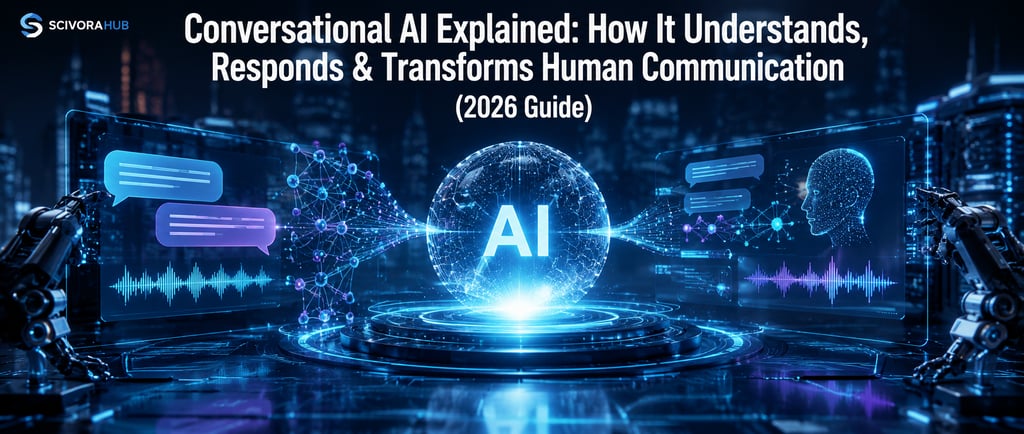
Conversational AI Explained: How It Understands, Responds & Transforms Human Communication (2026 Guide)
Introduction
Artificial Intelligence has changed the way people interact with technology, and Conversational AI is one of its most impressive innovations. Instead of simply responding to fixed commands, modern AI systems can understand natural language, remember context, interpret user intent, and generate human-like responses in real time.
From virtual assistants and AI-powered customer support to intelligent business applications, Conversational AI is transforming digital communication across industries. Unlike traditional chatbots that rely on predefined rules, modern Conversational AI combines Natural Language Processing (NLP), Natural Language Understanding (NLU), Machine Learning, and Large Language Models (LLMs) to create meaningful, context-aware conversations.
In this comprehensive 2026 guide, you'll learn how Conversational AI works, the technologies behind it, how it differs from traditional chatbots, and why it has become one of the most influential AI technologies of the modern era


Table of Contents
What Is Conversational AI?
How Does Conversational AI Work?
Core Technologies Behind Conversational AI
Conversational AI vs Traditional Chatbots
Voice AI vs Text AI
How Conversational AI Remembers Context
Real-World Applications
Benefits of Conversational AI
Challenges and Limitations
Future of Conversational AI
Frequently Asked Questions
Conclusion
Key Takeaways
Conversational AI enables human-like conversations using advanced Artificial Intelligence.
It combines NLP, NLU, Machine Learning, and Large Language Models.
Modern AI understands context instead of following simple scripted responses.
Voice assistants and AI chat systems both rely on Conversational AI technologies.
Businesses use Conversational AI to improve customer service, productivity, and automation.
Responsible AI development focuses on privacy, security, transparency, and ethical decision-making.
What Is Conversational AI?
Conversational AI is a branch of Artificial Intelligence that enables computers to communicate with humans using natural language. Instead of relying on predefined commands, these systems understand user intent, analyze context, and generate intelligent responses that closely resemble human conversations.
Modern Conversational AI powers AI assistants, virtual customer support agents, enterprise chat systems, educational platforms, healthcare assistants, and many other intelligent applications. Its goal is to make communication between humans and machines as natural and efficient as possible.
Unlike traditional software, Conversational AI continuously improves through machine learning and large-scale language models, allowing it to handle complex questions, follow multi-step conversations, and adapt to different communication styles.
How Does Conversational AI Work?
Conversational AI processes information through several intelligent stages. First, it receives user input through text or voice. If the input is spoken, speech recognition converts it into text. The system then uses Natural Language Processing (NLP) to break sentences into understandable language components.
Next, Natural Language Understanding (NLU) identifies the user's intent, extracts important information, and interprets the overall meaning of the conversation. Large Language Models analyze this information together with previous conversation history to understand context before generating the most appropriate response.
Finally, the AI creates a natural reply that is delivered back to the user as text or speech. This complete process usually takes only a fraction of a second, creating the impression of a smooth, human-like conversation.


Core Technologies Behind Conversational AI
Several advanced technologies work together to make Conversational AI intelligent and reliable.
Natural Language Processing (NLP)
NLP enables AI to read, process, and interpret human language. It converts raw text into structured information that machines can analyze effectively.
Natural Language Understanding (NLU)
NLU goes beyond recognizing words by understanding meaning, user intent, emotions, and context within a conversation.
Large Language Models (LLMs)
Large Language Models are trained on massive datasets containing books, websites, research papers, and conversations. These models help AI generate accurate, fluent, and context-aware responses.
Machine Learning
Machine Learning allows Conversational AI to improve continuously by learning from interactions and identifying language patterns over time.
Contextual Memory
Modern AI systems remember previous conversation history, enabling them to answer follow-up questions naturally without requiring users to repeat information.
Conversational AI vs Traditional Chatbots
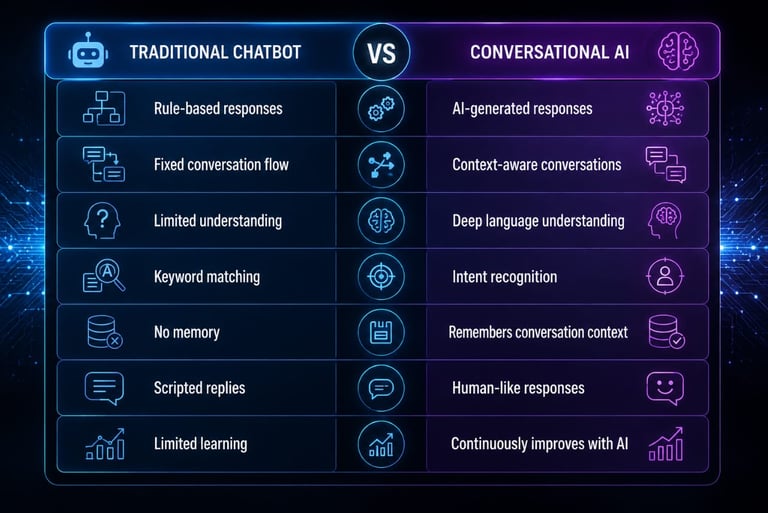
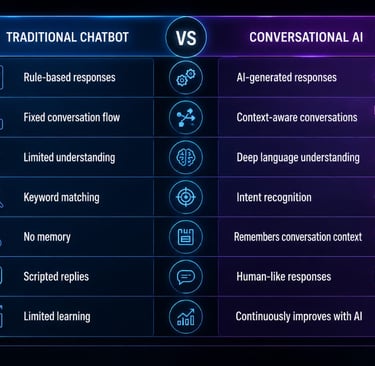
Traditional chatbots follow predefined rules and decision trees. They can only answer questions that have already been programmed into the system. If users ask something unexpected, the chatbot often fails to provide a useful response.
Conversational AI, on the other hand, understands intent, remembers previous messages, and generates intelligent responses using Large Language Models. Instead of matching keywords, it analyzes the meaning of the conversation, making interactions more natural and human-like.


The following comparison highlights the key differences between traditional chatbots and modern Conversational AI systems.
Voice AI vs Text AI
Modern Conversational AI works through both voice and text interfaces. Voice AI converts spoken language into text using speech recognition before processing it with language models. Text AI directly analyzes written messages and generates accurate responses.
Although both systems rely on similar AI technologies, Voice AI focuses on speech recognition and audio processing, while Text AI emphasizes written communication and conversational context.


How Conversational AI Remembers Context
One of the biggest advantages of modern Conversational AI is its ability to remember previous messages within a conversation. Instead of treating every question as completely new, it uses contextual memory and attention mechanisms to connect related information.
This allows users to ask follow-up questions naturally without repeating earlier details, making conversations smoother, faster, and more human-like.


Did You Know?
Modern Large Language Models can process thousands of words within a single conversation, enabling AI to maintain context, understand follow-up questions, and generate highly relevant responses.
Key Components of a High-Quality Conversational AI System
Instead of focusing only on features, understanding the building blocks of a reliable Conversational AI system helps explain why some AI assistants perform significantly better than others.
Essential Components
Accurate Natural Language Processing (NLP)
Advanced Natural Language Understanding (NLU)
Large Language Models (LLMs)
Context Memory
Intent Recognition
Response Generation
Knowledge Retrieval
Security & Privacy Protection
Human Feedback Integration
Continuous Model Improvement
💡 Pro Tip
When evaluating any AI chatbot, don't judge it by a single answer. Ask follow-up questions, change the topic, and test whether it remembers context. This is one of the easiest ways to identify a truly advanced Conversational AI system.
Challenges and Limitations of Conversational AI
Despite its impressive capabilities, Conversational AI still faces several challenges. AI models can occasionally generate incorrect information, misunderstand complex instructions, or produce biased responses if trained on imperfect data.
Organizations must also address privacy, cybersecurity, transparency, and responsible AI governance to ensure these systems remain safe, trustworthy, and beneficial for users.


Frequently Asked Questions (FAQs)
Conclusion
Conversational AI has fundamentally changed how humans interact with technology. By combining Natural Language Processing, Natural Language Understanding, Machine Learning, and Large Language Models, it enables intelligent, context-aware conversations that feel increasingly natural.
As AI technology continues to evolve, the focus is shifting from simply answering questions to delivering reliable, transparent, and human-centered communication experiences. Understanding how Conversational AI works helps individuals, businesses, and developers make better use of one of the most important Artificial Intelligence technologies of the modern era.
Author Box
Written by: Scivora Hub Editorial Team
Scivora Hub publishes well-researched articles on Artificial Intelligence, Technology, Education, Science and future innovations. Our goal is to make complex topics easy to understand through practical, reliable, and SEO-optimized content.
📍Trusted Resources
OpenAI : https://openai.com/
Microsoft AI : https://www.microsoft.com/ai
Google AI : https://ai.google/
NVIDIA AI : https://www.nvidia.com/en-us/ai-data-science/
IBM Research : https://research.ibm.com/artificial-intelligence
Stanford HAI : https://hai.stanford.edu/
📍Related Articles
Empowering global education through Artificial Intelligence, innovation, and trusted educational insights
Disclamer | Privacy | Policy | Terms & Conditions | Articles | About us | Contact
© 2026 Scivora Hub. All Rights Reserved..
AI • Education • Innovation • Global LearningS