Welcome To ScivoraHub Educational Platform

Google AI in 2026: Gemini, Vertex AI, DeepMind & the Future of Intelligent Technology
Discover how Google AI is transforming technology in 2026. Explore Gemini, Vertex AI, Google DeepMind, AI Studio, real-world applications, and the future of intelligent innovation.
ARTIFICIAL INTELLIGENCE
Scivora Hub Editorial Team
7/27/202615 min read
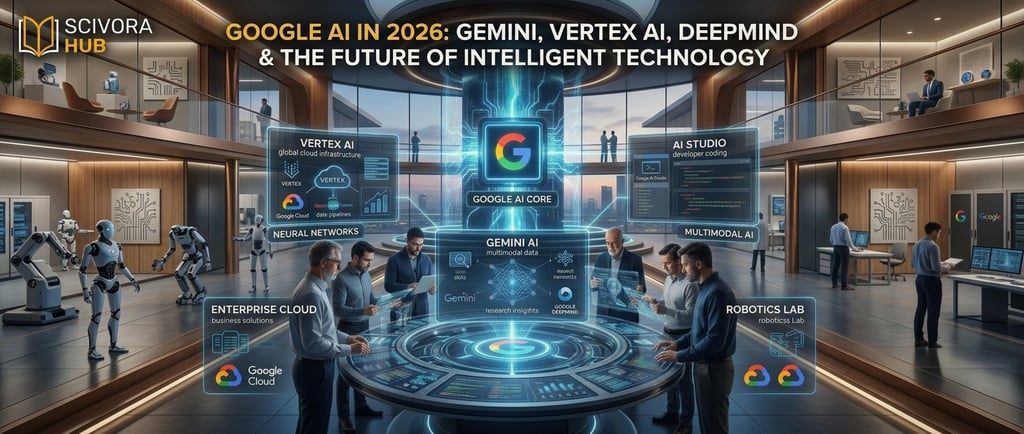
Google AI in 2026: Gemini, Vertex AI, DeepMind & the Future of Intelligent Technology
🔑 Key Takeaways
✔ Google AI is one of the world's most comprehensive artificial intelligence ecosystems, powering products used by billions of people.
✔ Gemini is Google's flagship multimodal AI model capable of understanding text, images, audio, video, and code.
✔ Vertex AI enables businesses to build, deploy, and scale AI applications using Google Cloud's enterprise infrastructure.
✔ Google DeepMind drives breakthrough AI research, advancing scientific discovery, robotics, healthcare, and next-generation machine learning.
✔ Google AI Studio simplifies AI development by allowing developers to prototype, test, and deploy generative AI applications efficiently.
✔ AI technologies are deeply integrated into Google Search, Gmail, Workspace, Android, Maps, YouTube, Photos, and Cloud services.
✔ Google's Responsible AI principles focus on safety, fairness, transparency, privacy, and long-term societal impact.
Table of Contents
Introduction
What Is Google AI?
The Evolution of Google's AI Ecosystem
Gemini: Google's Next-Generation AI Model
Vertex AI: Enterprise Intelligence in the Cloud
Google AI Studio for Developers
DeepMind: Advancing Artificial Intelligence Research
Google AI Across Everyday Products
Google AI vs Microsoft AI
Benefits of Google's AI Ecosystem
Challenges and Ethical Considerations
The Future of Google AI
Frequently Asked Questions
Conclusion
Introduction
Artificial intelligence is no longer a futuristic concept—it's becoming the foundation of how people search for information, create content, write code, analyze data, and interact with technology every day. At the center of this transformation is Google AI, an ecosystem that combines cutting-edge research, cloud computing, and intelligent software to power billions of digital experiences worldwide.
From Gemini, Google's advanced multimodal AI model, to Vertex AI, DeepMind, and Google AI Studio, the company has built a comprehensive platform that serves developers, businesses, researchers, and everyday users alike. These technologies are not only improving Google's own products but are also helping organizations build smarter applications, automate workflows, and accelerate innovation across industries.
In this guide, you'll discover how Google's AI ecosystem works, explore its most important technologies, understand real-world applications, compare its enterprise capabilities, and learn why Google continues to play a leading role in shaping the future of artificial intelligence.
What Is Google AI?
Google AI is the collective name for Google's artificial intelligence technologies, research initiatives, cloud platforms, and AI-powered products that are transforming how people interact with digital technology. Rather than being a single application or service, Google AI is a comprehensive ecosystem that combines advanced machine learning, large language models (LLMs), computer vision, speech recognition, robotics, and cloud computing to solve real-world problems at a global scale.
Over the past decade, Google has invested billions of dollars in AI research and infrastructure, making artificial intelligence a core part of nearly every product it develops. Today, Google AI powers services used by billions of people every day, including Google Search, Gmail, Google Photos, YouTube, Google Maps, Android, Workspace, and Google Cloud. Whether you're searching for information, translating languages, organizing emails, generating content, or navigating a new city, AI is working behind the scenes to deliver faster, smarter, and more personalized experiences.
One of the biggest strengths of Google AI is its ability to combine groundbreaking research with practical applications. Innovations developed by Google Research and DeepMind are often integrated into consumer products and enterprise solutions, allowing new AI capabilities to reach millions of users worldwide. This approach enables Google to continuously improve accuracy, efficiency, and user experience across its ecosystem.
Today, Google's AI portfolio includes several powerful technologies, each designed for different use cases:
Gemini — Google's flagship multimodal AI model capable of understanding and generating text, images, audio, video, and code.
Vertex AI — A cloud-based platform that helps businesses build, train, deploy, and manage AI applications at scale.
Google AI Studio — A developer-friendly environment for experimenting with Gemini models, testing prompts, and building generative AI solutions.
Google DeepMind — Google's advanced AI research division focused on scientific breakthroughs, healthcare, robotics, and next-generation intelligence.
Together, these technologies form one of the world's most advanced AI ecosystems, supporting everyone from individual creators and software developers to multinational enterprises and research institutions. As AI continues to evolve, Google is positioning itself not only as a technology company but also as a leader in shaping the future of intelligent computing.


The Evolution of Google's AI Ecosystem
Google's journey into artificial intelligence began long before generative AI became a global trend. For years, the company invested heavily in machine learning research to improve search quality, language translation, image recognition, and recommendation systems. These early innovations quietly transformed products that billions of people use every day, laying the foundation for one of the world's most advanced AI ecosystems.
As computing power increased and deep learning techniques matured, Google expanded its AI capabilities beyond search. The company introduced breakthroughs in computer vision, speech recognition, and natural language understanding, making services such as Google Translate, Google Photos, Google Assistant, and YouTube significantly smarter and more personalized. Instead of simply responding to user commands, these systems began learning patterns, recognizing context, and continuously improving through data-driven models.
A major turning point came when Google accelerated its AI research through the work of Google Research and DeepMind. These teams pioneered advances in neural networks, reinforcement learning, scientific discovery, and multimodal AI, helping Google move beyond traditional machine learning into a new generation of intelligent systems capable of reasoning across multiple types of information.
The launch of Gemini marked another milestone in Google's AI strategy. Designed as a multimodal model, Gemini can understand and generate text, images, audio, video, and code within a unified system. This represents a significant shift from earlier AI models that primarily focused on text alone. At the same time, Vertex AI and Google AI Studio made these innovations accessible to developers and businesses, enabling organizations to build enterprise-grade AI applications without managing complex infrastructure.
Today, Google AI is no longer limited to research laboratories. It powers consumer products, enterprise cloud services, healthcare innovations, cybersecurity solutions, education platforms, scientific research, and productivity tools used across the globe. By combining world-class research with scalable cloud infrastructure, Google continues to shape how artificial intelligence is developed, deployed, and integrated into everyday life.
Gemini: Google's Next-Generation AI Model
Gemini represents Google's most advanced family of artificial intelligence models, designed to understand and generate information across multiple formats instead of relying on text alone. As a multimodal AI model, Gemini can process text, images, audio, video, and programming code within a single intelligent system. This ability allows it to solve more complex problems, understand richer context, and deliver more accurate responses across a wide range of real-world scenarios.
Unlike earlier AI systems that specialized in one type of data, Gemini was built from the ground up to connect different forms of information. For example, it can analyze an image, explain what it sees, answer follow-up questions, summarize related documents, and even generate working code based on the same conversation. This makes interactions feel more natural and significantly expands the range of tasks AI can perform.
Google has integrated Gemini into many of its products and services, allowing millions of users to benefit from AI-powered assistance without changing the way they work. Professionals use it to draft reports, analyze spreadsheets, create presentations, generate software code, summarize lengthy documents, and accelerate research. Students can use Gemini to simplify complex topics, organize study materials, and improve productivity, while developers use it to build intelligent applications and automate repetitive programming tasks.
Gemini also plays a central role in Google's enterprise AI strategy. Through Google Cloud and Vertex AI, organizations can integrate Gemini into business workflows, customer support platforms, internal knowledge systems, and data analysis pipelines. This enables companies to improve efficiency, automate routine operations, and deliver better customer experiences while maintaining enterprise-grade security and scalability.
One of Gemini's greatest strengths is its continuous improvement through Google's research and infrastructure. As AI models become more capable, Gemini is expected to support increasingly sophisticated reasoning, stronger multimodal understanding, and deeper integration across Google's expanding ecosystem. Rather than functioning as a standalone chatbot, it serves as the intelligent engine powering many of Google's current and future AI innovations.

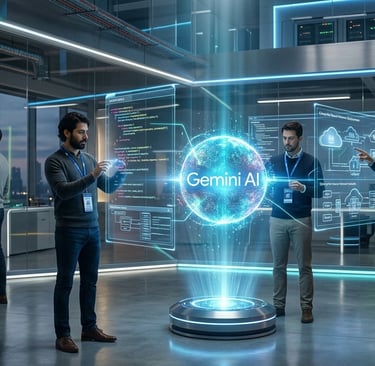
Vertex AI: Powering Enterprise AI Innovation
While Gemini represents Google's breakthrough in generative AI, Vertex AI is the platform that enables organizations to transform those capabilities into real-world business solutions. Built on Google Cloud, Vertex AI is a unified machine learning and generative AI platform that helps companies develop, customize, deploy, and manage AI applications from a single environment. It eliminates much of the complexity traditionally associated with machine learning, allowing teams to focus on innovation rather than infrastructure.
One of Vertex AI's biggest strengths is its end-to-end approach to AI development. Instead of using multiple disconnected tools for data preparation, model training, deployment, monitoring, and optimization, organizations can manage the entire AI lifecycle within one platform. This unified workflow improves collaboration between developers, data scientists, and business teams while reducing development time and operational costs.
Vertex AI supports both traditional machine learning models and modern foundation models such as Gemini. Businesses can fine-tune AI models using their own data, build intelligent chatbots, automate document processing, analyze customer feedback, generate content, and create predictive analytics solutions. Because the platform integrates directly with Google Cloud services, companies can securely connect AI applications to databases, APIs, data warehouses, and enterprise software without building complex custom infrastructure.
Scalability is another reason why enterprises choose Vertex AI. Whether an organization is developing a small internal productivity tool or deploying AI-powered services for millions of users, the platform automatically scales computing resources to meet demand. This flexibility makes Vertex AI suitable for startups, global enterprises, government agencies, research institutions, and multinational organizations operating in highly regulated industries.
Security and governance are also central to Vertex AI's design. Organizations have access to enterprise-grade identity management, encryption, compliance controls, access permissions, and monitoring tools that help protect sensitive information throughout the AI lifecycle. These capabilities are particularly valuable in sectors such as healthcare, finance, manufacturing, retail, and public services, where data privacy and regulatory compliance are critical.
Today, Vertex AI is helping businesses move beyond experimental AI projects toward production-ready intelligent systems. Companies are using the platform to improve customer experiences, automate repetitive workflows, accelerate software development, enhance decision-making, detect fraud, optimize supply chains, and unlock new business opportunities. As enterprise AI adoption continues to grow, Vertex AI is becoming one of the world's leading platforms for building scalable and responsible AI solutions.
Real-World Applications of Vertex AI
Organizations across industries are using Vertex AI in practical ways, including:
Healthcare: Supporting medical image analysis, clinical documentation, and healthcare research.
Financial Services: Improving fraud detection, risk assessment, and customer support automation.
Retail & E-commerce: Delivering personalized recommendations, demand forecasting, and inventory optimization.
Manufacturing: Predicting equipment maintenance needs and improving quality control.
Media & Marketing: Generating content, analyzing audience insights, and automating creative workflows.
Customer Service: Building intelligent virtual assistants capable of understanding natural conversations across multiple languages.
These real-world applications demonstrate how Vertex AI extends beyond experimental AI projects and delivers measurable business value across global industries.
Google AI Studio: Accelerating AI Development
As generative AI becomes more accessible, developers need tools that allow them to experiment, prototype, and deploy AI-powered applications quickly. Google AI Studio was created to simplify this process by providing an intuitive environment where developers can interact with Google's Gemini models without building complex infrastructure from scratch.
Instead of spending weeks configuring servers, APIs, and machine learning pipelines, developers can begin testing AI ideas within minutes. Google AI Studio provides a clean workspace for prompt engineering, response testing, model evaluation, and application prototyping, making it an excellent starting point for both beginners and experienced AI developers.
One of the platform's most valuable features is rapid experimentation. Developers can compare different prompts, evaluate AI-generated responses, adjust model behavior, and optimize outputs before integrating them into production applications. This iterative workflow helps improve accuracy, consistency, and overall user experience.
Google AI Studio also serves as a bridge between experimentation and enterprise deployment. Once developers have validated their ideas, projects can be expanded using Vertex AI and Google Cloud services to build secure, scalable applications capable of serving thousands—or even millions—of users.
Another advantage is support for multimodal AI development. Developers can build applications that understand text, images, and other forms of input, opening new possibilities for intelligent assistants, content generation, document analysis, visual search, educational platforms, and customer service automation.
The platform is widely used by startups, software companies, research organizations, and enterprise development teams because it reduces development time while encouraging innovation. By lowering technical barriers, Google AI Studio allows developers to focus on solving business problems rather than managing infrastructure.
As Google's AI ecosystem continues to evolve, AI Studio is becoming an essential tool for anyone interested in building modern AI applications. Whether you're creating a chatbot, an AI-powered productivity tool, or a large-scale enterprise solution, the platform provides an efficient path from concept to deployment.


DeepMind: Where AI Meets Scientific Discovery
While many people associate Google AI with products like Gemini or Google Search, some of the company's most groundbreaking innovations originate from Google DeepMind. Recognized as one of the world's leading artificial intelligence research organizations, DeepMind focuses on solving some of science and technology's most complex challenges through advanced AI systems.
DeepMind's mission extends far beyond building conversational AI. Its researchers work on developing intelligent systems capable of learning, reasoning, planning, and solving problems that were once considered impossible for machines. By combining deep learning, reinforcement learning, neuroscience-inspired approaches, and large-scale computing, DeepMind continues to push the boundaries of modern artificial intelligence.
One of DeepMind's most celebrated achievements is AlphaFold, an AI system that accurately predicts the three-dimensional structure of proteins. This breakthrough has significantly accelerated biological research by helping scientists better understand diseases, develop new medicines, and explore complex molecular structures. Researchers around the world now use AlphaFold to support discoveries in medicine, biotechnology, and life sciences.
DeepMind has also demonstrated remarkable progress in reinforcement learning. Its AI systems have mastered highly complex games, optimized energy consumption in data centers, improved robotic learning, and contributed to scientific research that requires analyzing enormous volumes of information. These achievements highlight how AI can move beyond automation and become a valuable partner in solving real-world scientific problems.
Healthcare is another area where DeepMind continues to make a meaningful impact. AI-powered diagnostic tools, medical imaging analysis, and predictive healthcare research have the potential to assist healthcare professionals in identifying diseases earlier and supporting better clinical decision-making. Although these technologies are designed to assist—not replace—medical experts, they demonstrate how AI can improve efficiency and patient outcomes.
Beyond healthcare, DeepMind's research influences robotics, climate science, mathematics, cybersecurity, energy optimization, and software engineering. Many of the innovations developed within DeepMind eventually contribute to Google's broader AI ecosystem, strengthening products such as Gemini, Vertex AI, and Google Cloud AI services.
What sets DeepMind apart is its long-term vision. Instead of focusing only on short-term commercial applications, the organization invests heavily in fundamental AI research that could shape the future of intelligent systems for decades to come. This balance between scientific exploration and practical innovation has positioned DeepMind as one of the most respected AI research organizations in the world.
As artificial intelligence continues to evolve, DeepMind will likely remain at the forefront of breakthroughs that redefine what's possible—from accelerating scientific discovery to developing safer, more capable, and more responsible AI systems that benefit society on a global scale.


Google AI Across Everyday Products
One of Google's greatest advantages in artificial intelligence is that its technologies are already embedded into products used by billions of people every day. Unlike many AI platforms that operate as standalone services, Google integrates AI directly into its consumer applications, enterprise software, and cloud infrastructure, making intelligent features a natural part of everyday digital experiences.
In Google Search, AI helps users receive more relevant, contextual, and informative results. Advanced language understanding enables the search engine to interpret user intent rather than simply matching keywords, improving the quality of answers for complex questions.
Gmail uses AI to prioritize emails, detect spam and phishing attempts, suggest smart replies, and assist users while writing messages. These intelligent features save time while improving communication and security.
Within Google Workspace, AI enhances productivity across Docs, Sheets, Slides, Meet, and Drive. Professionals can draft documents, summarize meeting notes, generate presentations, analyze spreadsheets, and organize information more efficiently, reducing repetitive work and allowing teams to focus on higher-value tasks.
Google AI also plays an important role in Android, where it improves voice recognition, live translation, accessibility, battery optimization, camera performance, and personalized recommendations. Millions of smartphone users benefit from AI without realizing how extensively it operates behind the scenes.
In Google Photos, AI automatically organizes images, identifies people, objects, and locations, and simplifies searching large photo libraries. Meanwhile, Google Maps uses AI to predict traffic patterns, recommend efficient routes, estimate travel times, and improve navigation accuracy.
For developers and businesses, Google Cloud integrates AI into analytics, cybersecurity, customer service, software development, and enterprise automation. This unified ecosystem demonstrates how AI has evolved from an experimental technology into an essential part of everyday digital life.


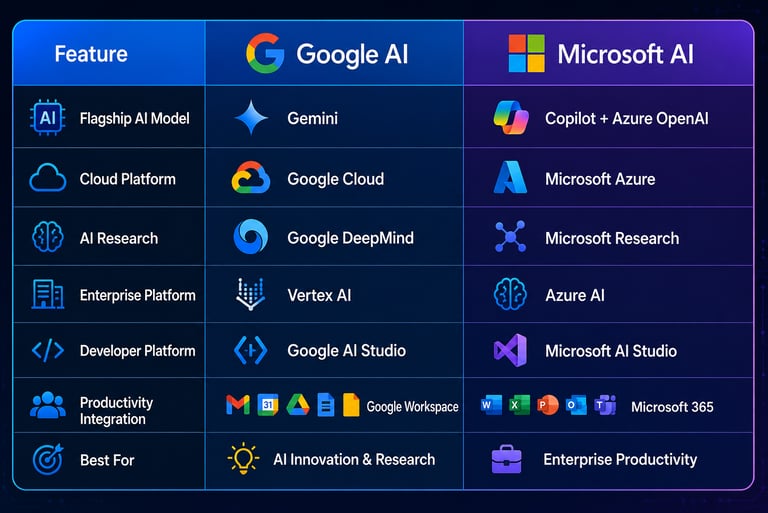
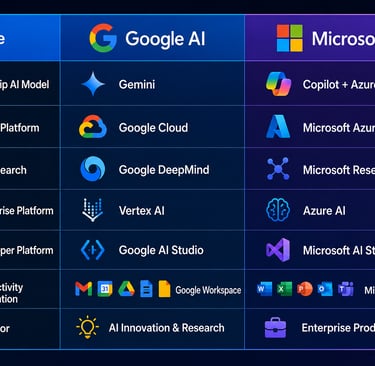
Google AI vs Microsoft AI
Google and Microsoft are two of the world's leading AI innovators, but their strategies focus on different strengths. Google emphasizes research, multimodal AI, cloud-native development, and consumer-scale AI services, while Microsoft concentrates on enterprise productivity, cloud integration, and business-focused AI solutions.
Although both companies invest heavily in responsible AI and cloud infrastructure, their ecosystems are designed to address different user needs. Choosing between them depends on your goals, technical requirements, and preferred development environment.
Benefits of Google's AI Ecosystem
Google has built one of the most comprehensive AI ecosystems in the world by combining cutting-edge research, cloud infrastructure, and consumer technologies into a unified platform. This approach enables individuals, developers, and organizations to access advanced AI capabilities without building complex systems from scratch.
One of the biggest advantages is scalability. Whether you're an independent developer creating your first AI application or a global enterprise serving millions of users, Google's AI infrastructure can grow alongside your needs. Platforms like Vertex AI and Google Cloud provide the flexibility to deploy AI solutions securely and efficiently across different industries.
Another major benefit is multimodal intelligence. With Gemini, AI is no longer limited to understanding text. It can process images, audio, video, documents, and programming code within a single model, enabling richer and more natural human-computer interactions.
Google also invests heavily in developer accessibility. Through Google AI Studio, comprehensive APIs, and extensive documentation, developers can prototype, test, and launch AI-powered applications more quickly than ever before.
Businesses benefit from Google's strong focus on security, reliability, and global infrastructure. Enterprise customers can integrate AI into existing workflows while maintaining high standards for data protection, governance, and compliance.
Perhaps the greatest strength of Google's ecosystem is its continuous innovation. Research breakthroughs from DeepMind and Google Research are regularly transformed into practical tools that improve productivity, scientific discovery, education, healthcare, cybersecurity, and countless other fields.
Challenges and Ethical Considerations
Despite its remarkable progress, Google AI also faces important technical and ethical challenges. Like other advanced AI systems, large language models may occasionally generate inaccurate information, misunderstand complex contexts, or produce responses that require human verification.
Privacy and data security remain critical concerns as AI becomes increasingly integrated into cloud services and digital products. Organizations must implement responsible governance practices, protect sensitive information, and ensure that AI systems comply with regional and international regulations.
Another challenge involves bias and fairness. AI models learn from vast datasets, and if those datasets contain imbalances, the resulting systems may unintentionally reflect them. Continuous testing, evaluation, and responsible AI practices are therefore essential to improve accuracy and fairness.
Google continues to invest in AI safety research, transparency, model evaluation, and responsible development. These initiatives aim to ensure that future AI systems remain reliable, secure, and beneficial for society while minimizing potential risks.
The Future of Google AI
Google's AI journey is only beginning. Over the coming years, artificial intelligence is expected to become even more deeply integrated into search, cloud computing, scientific research, healthcare, education, software development, robotics, and everyday digital experiences.
Future versions of Gemini are likely to deliver stronger reasoning, improved multimodal understanding, faster performance, and more personalized assistance. Meanwhile, Vertex AI and Google Cloud will continue enabling organizations to build increasingly sophisticated AI applications for global markets.
Google DeepMind's research is also expected to drive major scientific breakthroughs in medicine, climate science, robotics, mathematics, and advanced computing. These innovations could reshape entire industries while expanding the role of AI in solving complex global challenges.
As AI continues to evolve, Google is well positioned to remain one of the world's leading innovators, combining world-class research with practical technologies that empower billions of users and millions of businesses worldwide.
📍 Did You Know?
Did You Know?
Google processes billions of searches every day, and artificial intelligence plays a key role in improving search quality, language understanding, spam detection, recommendations, and personalized user experiences across many of its products.
📍 Pro Tip
Pro Tip:
If you're planning a career in AI or cloud computing, learning Gemini, Vertex AI, Google AI Studio, and Google Cloud together will provide a strong foundation for building next-generation AI applications.
Frequently asked questions
What is Google AI?
Google AI is Google's artificial intelligence ecosystem that includes AI research, cloud platforms, developer tools, and intelligent products powered by machine learning and generative AI.
Is Google DeepMind different from Google AI?
DeepMind is Google's advanced AI research division, while Google AI refers to the broader ecosystem of AI technologies, products, and services.
What is Gemini?
Gemini is Google's multimodal AI model capable of understanding and generating text, images, audio, video, and code.
Can developers use Google AI for free?
Some Google AI services provide free access or trial options, while advanced enterprise features may require a Google Cloud account and paid usage.
What is Vertex AI used for?
Vertex AI is Google Cloud's enterprise platform for building, deploying, and managing machine learning and generative AI applications.
Which industries use Google AI?
Healthcare, finance, retail, education, manufacturing, media, cybersecurity, logistics, and software development are among the many industries adopting Google AI technologies.
Conclusion
Artificial intelligence is rapidly reshaping the digital world, and Google has positioned itself at the forefront of this transformation. Through technologies such as Gemini, Vertex AI, Google AI Studio, and DeepMind, the company has created a powerful ecosystem that supports innovation across research, business, cloud computing, and everyday digital experiences.
Whether you're a student exploring AI, a developer building intelligent applications, or a business leader planning enterprise automation, understanding Google's AI ecosystem provides valuable insight into where modern technology is heading. As research and innovation continue to accelerate, Google AI will remain a key force driving the next generation of intelligent computing.
Author Box
Written by: Scivora Hub Editorial Team
Scivora Hub delivers in-depth, research-driven content covering Artificial Intelligence, emerging technologies, science, digital innovation, and future trends. Our mission is to make complex technologies accessible through accurate, engaging, and globally relevant content.
Trusted Resources
Google AI
Google DeepMind
Vertex AI
https://cloud.google.com/vertex-ai
Google AI Studio
Google AI Principles
https://ai.google/responsibility/principles
Google Research
Related Articles
Microsoft AI in 2026: Azure AI, Copilot & Enterprise AI Ecosystem
AI Agents Explained: How Autonomous AI Systems Work
Conversational AI: The Future of Human-Computer Communication
What Is Deep Learning AI?
Best AI Tools for Students in 2026
Empowering global education through Artificial Intelligence, innovation, and trusted educational insights
Disclamer | Privacy | Policy | Terms & Conditions | Articles | About us | Contact
© 2026 Scivora Hub. All Rights Reserved..
AI • Education • Innovation • Global LearningS